Guide and scorecard · Level design
The fun check
41 checks that tell you if a platformer level will be fun, before you spend a day building it. Read the rules, plan your level in nine lines, then score it right here.
01Why a checklist
When we built the canyon in our own game, The Exiled King, it took about 12 rounds over four days to get right. Every problem was found by someone playing it, never by looking at screenshots: first it was “ugly”, then safe drops and deadly drops looked the same, then the deadly water was hidden under the ground.
So we ran five research passes on how the best platformers teach, challenge and pace their levels. We read talks from GDC (the big yearly game-maker conference), developer blogs and interviews, the published Celeste source code, Steam review data, Game Maker’s Toolkit (a game design video series) and The Level Design Book (a free online book). Then we turned it into one checklist. It took 21 minutes to write, and every level since has been planned with it.
The fun check has 41 checks: 39 from that research, plus two we added after it missed things in our own levels. You run it three times per level. It works for any 2D platformer or metroidvania (an explore-and-unlock game, like Hollow Knight). Most of it works for any game built from levels.
02The five rules underneath
Every check comes back to one of these.
One idea per level, in four beats
Meet it safely, develop it, twist it, give it a final test, then drop it. Nintendo, Ubisoft’s Rayman team, Celeste, Yacht Club and Ori all work this way under different names.123
The first meeting is safe
Anything new is first met alone, easy to see, and somewhere a mistake costs seconds. Use on-screen text only for a button the player could never discover.
Cheap failure keeps it fun
The best games keep the challenge and cut the cost of failing: back to life in under a second, a checkpoint (a restart spot) at every hard part, nothing permanent lost.4felt difficulty = chance of dying × cost of dying
Seen before it can hurt
Every hazard and landing is on screen before you commit. What looks solid is solid. Most “unfair” complaints are really about something hard to see, or about collision (the invisible shapes the game treats as solid).5
Boredom comes from sameness
Empty walks, repeated challenges, filler pickups. Retire an idea after about five minutes, and put one surprise in every level.
The four beats, drawn
Here is one idea, crumbling ledges, played out across one level.
One crumbling ledge over solid floor. A slip costs nothing.
A row of them over a pit. Same rule, real stakes.
Now they crumble the moment you land. The idea itself changes.
Everything at its biggest, with a chase. Then retire the idea.
Why cheap failure matters
How hard a game feels depends on two things: how often you die, and what each death costs you. Dying a lot is fine when you’re back in a second.
The shape of a level
03How to run it
Run it three times. Each pass catches what the others miss.
Paper
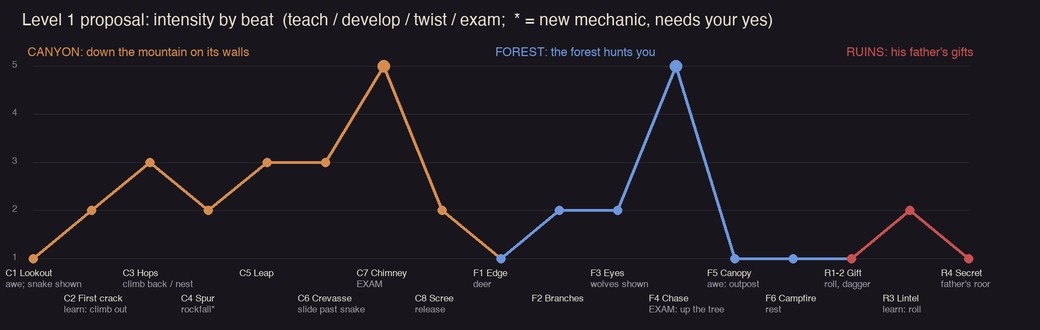
Read your level plan and beat chart (a one-page plan of how intense each part of a level feels) against every check. Fill in the scorecard.
Catches: no clear idea, no twist, no rest, no big finish, nothing optional.
Play
Build a greybox (a rough version built from plain grey blocks). Play it yourself five times, once with the game drawing its collision shapes on screen. Then watch one person who has never seen it, without helping.
Catches: jumps you can’t see the end of, art that doesn’t match what’s solid, unclear routes, dull stretches.
Player
After each playtest (watching someone else play your game), read where people died and where they quit, plus their notes. Score the last group of checks, “The player’s evidence”.
Catches: unfair spots, walls that make players quit, boredom, “what was that?”
For the curious: seeing collision shapes
Most engines can draw the invisible solid shapes over your art while the game runs. In Godot, open the Debug menu at the top of the editor, tick Visible Collision Shapes, then run the game. Each shape shows as a coloured outline.
Walk every ledge and wall. Anywhere the outline and the art disagree, the player will feel cheated.
Scoring
- Must checks all pass before a level counts as done.
- Should checks mostly pass. More than three misses means the level needs another pass.
- Bonus checks are nice to have.
The numbers in the checks (seconds, counts) are starting points from the research. Tune them with your own playtests.
04Plan the level in nine lines
Fill this in before you build anything. It’s the level template from our breakdown of every level in Donkey Kong Country: Tropical Freeze and Super Mario Bros. Wonder, 134 in all.6 Your answers save in this browser, and you can copy them out.
One platform, creature or object. Name the level after it: “The Snapping Boughs”.
A pit, spikes, water. If the floor is safe, name where the pressure comes from instead.
Meet (safe), develop (over danger), twist (the same thing changes), test (at its biggest).
Size every gap to a move. Makeable gaps read clearly makeable, impossible ones clearly impossible. Change one thing at a time.
3 or 4 sections, each calm then tight. A checkpoint at the door of the twist and of the finale, with health a few steps after.
On a landing, in a jump’s arc, as the only bridge, or as a tool. Never at random.
One step off the path, marked by the odd one out, costing a little risk.
What threat waits there before it arrives? What story plays there?
List every object in the path and its job. No job: move it to the background or delete it.
05The scorecard
Score each check Pass, Partial or Miss. The summary tells you whether the level is ready and what to fix first. Everything saves in this browser only.
The list opens on the must-pass checks, so you start with what matters most. Press “All checks” to see all 41.
By hand vs with the coach
Scoring a level by hand works, and it’s worth doing. The Dream Game Coach does it for you: it drafts your beat chart, places every platform in a blueprint, checks every jump can be made, and scores the level before you build anything. See Premium
06Red flags: stop and fix
- The level’s idea needs a sentence with “and” in it twice.
- A new thing can kill you the first time you meet it.
- You make a jump every time, but a new player can’t see where it lands.
- You catch yourself holding right on the controller and thinking about something else.
- Testers die at one spot and say “what?”
- A collectible sits on the main path, or the path needs it.
- The finale is just the level made longer.
- The big moment uses a move the level never taught.
07Reading a playtest
Watch silently and trust what players do over what they say. Log five things: deaths per room, time per room, how often they switch on easy-mode settings, how often they open the map, and where they quit.7
Deaths in one exact spot
Something there is broken. Look at what the player can see, the solid shapes and the camera.
Deaths spread across a challenge
Usually a fair skill test. The shaded part is the challenge you planned.
| What you see | Likely problem |
|---|---|
| Deaths clustered on one exact spot | Something is hard to see, the solid shapes don’t match the art, or the camera hides the danger. One study found broken levels using death data from just five players.8 |
| Deaths spread across a challenge | Usually a fair skill test |
| Repeated tries at a route you didn’t mean | It doesn’t look impossible enough |
| “I didn’t touch it”, “what hit me”, “I pressed jump” | Collision, something hard to see, or input lag (a delay between pressing and acting) |
| Sighs when they come back after a death, fewer tries per sitting | Coming back, or the walk back to the hard part, takes too long |
| Looping back and forth, “where now?” | Lost |
| Running past things, skipping pickups | Boredom, or filler that adds time but no fun |
| Nobody can name what was new in the last five minutes | Too few ideas |
| A new ability goes unused | It only opens doors, like a key, or it was never taught |
08How we used it
On The Exiled King, the check changed how levels were made. Each section got a beat chart first: the idea, the twist, meet, test, a rest, one moment of awe, and a checkpoint before each test. The level was built beat by beat from that plan. Small test scripts walked the route and tried every jump to prove it could be made. Then a person played each section before the next one was built.


AI Game Bootcamp Premium
Go from guide to finished game
This guide gives you the checklist. Premium gives you a coach that plans and checks every level with you.
- The Dream Game Sprint video masterclassComing soon
Step-by-step video lessons from first idea to launch day. - The full Dream Game Coach for Claude Code
It guides your game every day: research, design, levels, art, sound, playtests and launch, with automatic checks. - A personal gameplay review from John
Honest notes on your game from someone who ships them.
09Words you’ll see
- Playtest
- Watching someone else play your game.
- Greybox
- A rough version built from plain grey blocks.
- Collision
- The invisible shapes the game treats as solid.
- Hitbox
- The invisible shape that decides what touches what.
- Set piece
- A big, memorable moment, often the finale.
- Metroidvania
- An explore-and-unlock game, like Hollow Knight.
- Beat chart
- A one-page plan of how intense each part of a level feels.
- Beat
- One step of a level’s idea: meet, develop, twist or test.
- Twist
- A change that makes a known idea feel new.
- Checkpoint
- The spot you restart from after a death.
- Intensity curve
- How tense a level feels, moment by moment.
- Hook
- The one idea that makes your game stand out.
10Sources
The fun check comes from our platforming research (October 2026) and our level-by-level audit of Tropical Freeze and Wonder. These are the main outside sources behind it.
- Kotaku, “What made Super Mario 3D World so great”, on Nintendo’s four-step level design. kotaku.com
- Game Developer, “Rational Design: the core of Rayman Origins”. gamedeveloper.com
- Yacht Club Games, Specter of Torment level design deep dive, part 2. yachtclubgames.com
- Game Developer, Edmund McMillen on why Super Meat Boy is so hard. gamedeveloper.com
- Game Developer, Itay Keren, “Scroll back: the theory and practice of cameras in side-scrollers”. gamedeveloper.com
- Our own audit of all 57 Tropical Freeze levels and 77 Wonder main courses, from their full walkthroughs, Super Mario Wiki and developer interviews (October 2026).
- The Level Design Book, playtesting. book.leveldesignbook.com
- Trier University of Applied Sciences, report on level analysis from player death data (2015). hochschule-trier.de
- Dan Taylor, “Ten principles of good level design”, GDC 2013. gamedeveloper.com
- The Level Design Book, blockout. book.leveldesignbook.com